You Can Also Visit

Showing posts with label job search. Show all posts

Thursday, September 19, 2013

Getting Started on Recruit-A-Duke


STEP 1: Log on to Recruit-A-Duke

All current students receive a Recruit-A-Duke account (incoming freshmen will receive an account in their second semester at JMU).  Upon receiving your login information via email, you have the ability to upload your resume and submit it to various job and internship postings on Recruit-A-Duke that fit your interest. 

If you are unable to locate your login information, click on the Forgot Password option on the login screen to receive a new password.

STEP 2: Update your profile

After logging in, we ask that you click on the Profile tab to verify and update your academic and personal profile information.  In your profile, you must also click on the Privacy tab to read and agree to the Authorization Statement.

STEP 3: Have your resume reviewed and upload it

There are several opportunities to have your resume reviewed. After you receive your resume review, you can upload it to Recruit-A-Duke by logging in and selecting the Resumes and Other Documents tab.

STEP 4: Become eligible for On-Campus Interviewing and Mock Interviews

To be eligible to interview with employers on campus or conduct a mock interview, you must complete the online tutorial. (You must watch the tutorial in its entirety, but you can also access the script from the tutorial if you need to refer to it later.)
Be sure to follow the steps in the workshop carefully, otherwise you will not prompt the system to document your name and email address. This will result in us not having the proper information needed in order to grant you access to On-Campus Recruiting.

Need help?

If you have any questions concerning this process or the Recruiting Services Program, please contact the Recruiting Services Team at 540-568-7379 or email recruitaduke@jmu.edu.


Friday, August 23, 2013

Meet Your New Liaison!


Meet Your New Liaison!


Who I am: A Career and Academic Advisor with Career and Academic Planning, your new
liaison!

Where I am from: Hunterdon County, New Jersey

Where I went to school: The College of New Jersey (2010) James Madison University (2013)

What I want to be when I grow up: Still working on it!

Favorite college activity: Being an ambassador. I loved meeting prospective students.

Favorite part of JMU: The Views. My office in Wilson overlooks the Quad – it’s breathtaking!

Favorite JMU Memory: Getting my picture taken with President Alger at the Purple Out. He was so nice!

When I am not at JMU, I am … Hanging out with my puppy, Dixie.

What I can help with:
  • ·      Resume Reviews
  • ·      Cover Letter Reviews
  • ·      Job/Internship Searches
  • ·      Choosing/Changing A Major
  • ·      Interviewing Concerns/Questions
  • ·      The Graduate School Search
  • ·      Class/Club Presentations


What I wish I had known earlier in college: To get involved! JMU in particular has an abundance of resources for students – this is the time to take advantage of them! We are all invested in your success and want this to be the best four years of your life – academically, professionally, and personally.  

Where you can find me: In ISAT 313 on Wednesdays from 2 -5, Wilson 301 every other weekday.

How you can contact me: Email: sowdenka@jmu.edu, Phone: 540-568-6555

Looking forward to meeting you soon!
Kristin Sowden, Technology Liaison
Career and Academic Planning
540-568-6555
sowdenka@jmu.edu

Tuesday, March 26, 2013

The 9 things that matter more to employers than grades

By Becky Johns | Posted: March 7, 2013


This story first appeared on PR Daily in May 2011.

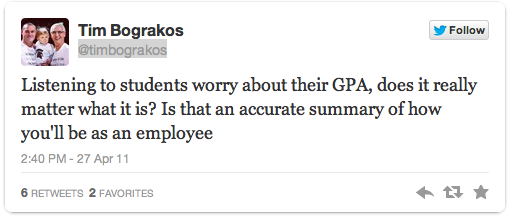
A friend who works with the alumni association at my alma mater asked an interesting question on Twitter.


The tweets poured in, and the overwhelming sentiment was that college GPA matters very little in professional success.

Grades are the determining factor for performance in school. But in the professional world, that’s not how it works. Your bosses won’t tell you which questions will be on the test.

Your college GPA is a combination of several factors but isn’t really the best indicator of how you’ll perform in the working world. We all know that person with perfect grades who struggles socially or that person who couldn’t care less about school but seems to have no trouble making great things happen in their life. Book smarts and street smarts are very different things.

Take your classes seriously. Do the work. Show up and learn something. Meet your professors. But I’m here to tell you, the GPA you achieve in college doesn’t matter.

Here’s what does:

1. Knowing how you learn

Spend time during college determining how you best learn and retain information. Some people need to see it, some need to hear it, some need to write it, and some need to practice it before it sticks. As an employee, you’ll need to learn new things as you go, remember them, and prove you’ve absorbed the information.

2. Applying theory to real-life situations

It’s one thing to recite the 4 P’s of marketing or learn how the purchase decision funnel looks on paper, but things won’t always happen in the marketplace the way they do in your textbooks. Learn how to take fundamental information and proven best practices and apply them in new situations or projects. The real world will always throw new variables at you, so knowing how to adapt theory to practice is crucial.

3. Time management

Learn how much time you need to research and write a paper, get to your classes and jobs on time, fit a workout in your day, and still have something of a social life. Time management is a vital skill. In your professional life, you’ll need to know how to manage your time to meet deadlines, tackle to-do lists, and avoid banging your head against the wall in the process.

4. Relevant professional experience

Jobs, internships, student organizations, and volunteer projects in your industry will prepare you best for the working world. Do as much as you can to work in your field during college and learn about what you want to do (or in same cases, what you don’t want to do). Your future employer will take your experience as the absolute best indicator for your potential in a new position.

5. A portfolio proving you can produce work

Keep samples of your best work from classes and internships. Many employers will want to see your work before hiring you. If you’re not building a portfolio through things you’re required to do before you graduate, then produce these things on your own time. Practice writing articles, press releases, pitches, designing publications, compiling clip reports, research summaries, or anything else you might be hired to do. Practice is important.

6. The ability to give and receive feedback

Learning to accept praise and criticism is incredibly important. You’ll participate in employee reviews with your boss someday, so the ability to hear different types of feedback, internalize it, and adjust accordingly will matter to your job performance.

It’s also important to learn to how to give feedback to others. When you collaborate with colleagues, you’ll have to offer positive and negative comments on others’ work.

7. Presentation skills

Offer to be the speaker on behalf of your group in your classes, and learn how to present your projects as an intern. The ability to convey ideas clearly, speak confidently with your bosses, and discuss your experience in interviews will be an important part of your professional life.

8. Writing skills

It’s sad how many students leave college lacking solid writing ability. Focus on developing this skill, because it will matter in everything from reports to pitches to emails. You don’t have to become a blogger, but finding places to practice writing content and have it edited will really help improve your skills.

9. Your network

You’ve heard it many times: “Who you know is more important than what you know.” It’s true. (It’s what you need and who you know.) Start building your network right away. Get in the habit of meeting new people, nourishing your relationships, and helping others by making introductions. You are most likely to find job opportunities through your network. Build it!

What else matters more for students than GPA? Or am I wrong? Is GPA more important than I’ve made it out to be?

A version of this story first appeared on Becky Johns’s blog.

Monday, March 11, 2013

College Seniors The Time to Find a Job is Now

By: Bruce Kasanoff

First, let's be clear. Your goal isn't to get a job this month, but rather to lay the groundwork so that you'll have a great job when you graduate.

Start conversations, not interviews: Before you get interviews or offers, you need to start interacting with people who are already in the workforce. Reach out and have intelligent conversations with them.

Contact alumni from your school who are working in industries or jobs that might appeal to you. Reach out to friends of your parents, neighbors or professors. Read articles like crazy, and send notes to those who wrote or were featured in articles you found interesting.

You have two goals in these outreach efforts. The first is to learn about what people do and where you might best fit in. The second is to create a line of evidence (for use months later, when firms are hiring), that you really do have strong interest in a particular area. One of the best things that can happen in, say, early April is for an executive to observe, "I remember you. We talked back in February."

Interact with class:
Not everyone follows through in a professional manner, and the people who do stand out. Value the time of every person to whom you speak. Do your research before you speak and know as much as you can about his or her company, division and job.(Example: is their stock up or down? Why?)

Send thank you notes immediately after speaking to someone. When you connect with another person to whom they introduced you, send a brief note to let them know, and to thank them again.

Be incredibly curious: You're about to take one of the pivotal steps of your entire life, and the job hunting process doesn't have to be stressful. You can think of it like being a kid in a candy store. Learn as much as you possibly can. Read everything you can get your hands on about intriguing companies, industries and opportunities. When you get a chance to talk with someone, be genuinely interested. The depth and intelligence of your questions are one of the best ways you have to demonstrate that you are a person with true potential.

Get real: Coming out of business school, I interviewed with one of the top consumer goods companies and was telling the interviewer all about what I could do for his firm. He finally stopped me and asked, "Do you have any idea what an assistant product manager does?" I didn't, and was pitching like a budding CEO, instead of someone who is going to add numbers and follow-up on details.

You're going to have to pay your dues, and prove your value. Understand the realities of the jobs they give recent college grads. When you describe your skills, explain them in this context.

Set your expectations right:
Your first job isn't going to make your dreams come true. It's a transition between school and a career. Don't expect self-actualization, incredible wealth, and six weeks of vacation.

But you should expect to work for a company you respect, and with people from whom you can learn. If an offer doesn't provide you with a positive step in the right direction, don't take it.

Will you be successful?

The job market remains challenging. Not every college graduate will get a great job. But if you start taking these steps right now, you will vastly increase your odds of success.